
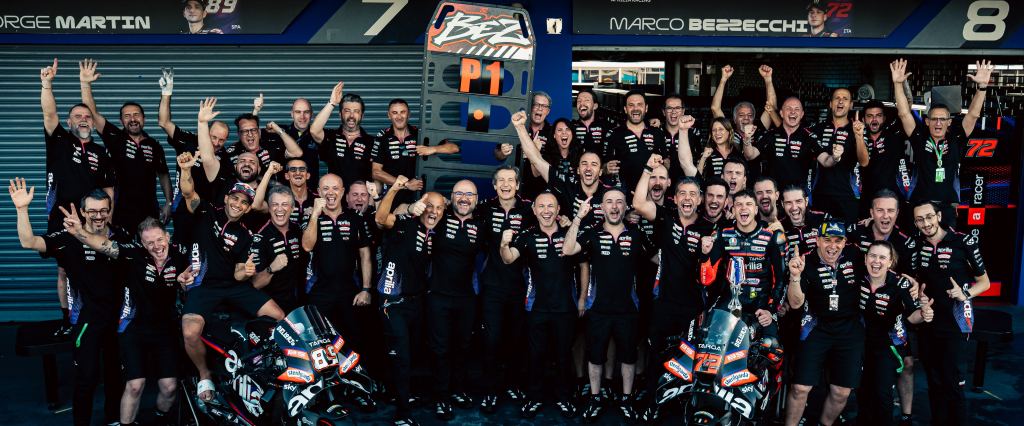
Despite delivering its most successful MotoGP season to date—four race victories, second in the manufacturers’ standings, and third in the riders’ championship—Aprilia enters the 2026 season without a title sponsor. In fact, it is the only manufacturer on the grid this year lacking a major commercial partner.
This absence is surprising given what Aprilia offers potential sponsors. The team boasts two of the most valuable rider properties in MotoGP:
• 2024 World Champion Jorge Martín, the first rider in history to win the title on an independent (non‑factory) team, and
• Marco Bezzecchi, the charismatic Italian and VR46 Academy graduate who finished third in last year’s championship in his debut Aprilia season and has dominated preseason testing, positioning him as a genuine title contender.
Aprilia also carries one of the richest racing pedigrees in the sport, with 54 world titles across its history. Yet it remains one of the smallest manufacturers on the grid—punching far above its weight against mass‑market giants like Honda and Yamaha, who’s recent on‑track performance pales in comparison to Aprilia’s upward trajectory.
So why hasn’t Aprilia been able to convert its competitive success and compelling brand story into major sponsorship deals? From a marketing perspective, the answer is layered.
The commercial reality: sponsorship is not charity
Brands do not sponsor MotoGP teams out of goodwill. At this scale, sponsorship must deliver something commercially meaningful, whether that’s strategic alignment, brand visibility, access to a target market, or a shift in consumer perception.
Sponsorship sits within the promotional mix—its purpose is to inform, persuade, or remind consumers in ways that influence attitudes or behaviours. For a brand to commit millions to a MotoGP partnership, one thing the team must do is reinforce or elevate the brand’s positioning.
Why positioning matters
Positioning is a key part in company and brand strategy. Positioning defines how a brand wants to be perceived—its identity, values, and points of difference. It shapes the associations consumers hold. For example, Apple’s positioning evokes innovation, premium design, and cultural cool.
One way sponsorship works is through association transfer. If Apple were to sponsor a MotoGP team, the traits consumers associate with Apple—innovation, creativity, progressiveness—would transfer to the team. Conversely, the team’s traits would transfer back to Apple. This two‑way exchange is why alignment is critical.
A strong example is Lenovo and Ducati: both brands share associations with innovation, performance, and premium engineering. Their partnership reinforces these shared attributes and allows each to tap into the other’s fan base, strengthening credibility and awareness in adjacent markets.
Aprilia’s brand strengths—and its limitations
Aprilia does have powerful associations. Being an Italian brand is its greatest asset. Italian products enjoy some of the strongest country‑of‑origin effects in global marketing: craftsmanship, design sophistication, passion, performance, luxury, and exclusivity. Think Ferrari, Versace, Gucci, and even Ducati.
But unlike these brands, Aprilia lacks global brand awareness, familiarity, and top‑of‑mind recognition in a crowded market category. It is overshadowed by Ducati (supported by the Volkswagen Groups deep pockets and marketing skill) and by Japanese competitors with far larger dealer networks, deeper and wider product offerings and greater marketing budgets. Aprilia’s promotional footprint is narrow because its primary marketing vehicle is racing. This creates deep but narrow awareness—strong among MotoGP fans, weaker among casual riders or mass‑market consumers.
This isn’t inherently a problem, but it does limit the pool of brands with compatible positioning and sufficient marketing budgets. As a result, Aprilia tends to attract niche, engineering‑focused, or European premium suppliers, rather than global luxury or consumer brands.
When sponsorship is about reaching a target market
Brands also sponsor things to reach specific audiences. A strong example is ABB’s partnership with Formula E. ABB is known for industrial automation and robotics—traditionally a B2B brand with little consumer visibility. Formula E, however, appeals to a younger, sustainability‑minded audience and is built around electrification and environmental innovation.
By sponsoring Formula E, ABB gained:
• associations with sustainability and future mobility,
• visibility with consumers, governments, and companies investing in clean energy, and
• a platform to communicate its strategic pivot into EV charging and smart energy systems.
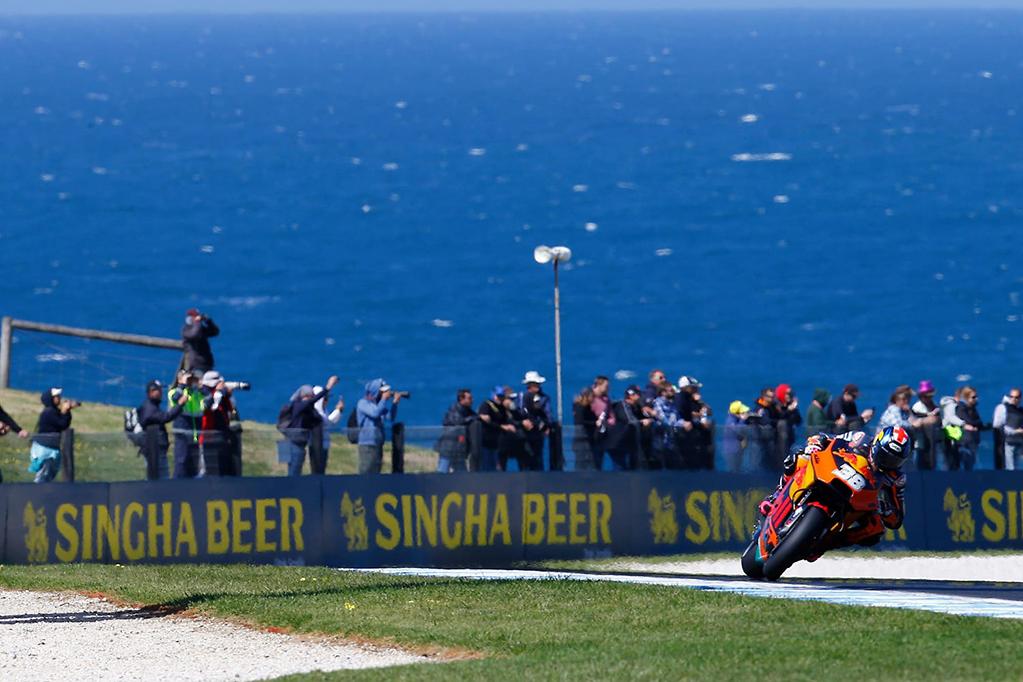
This is sponsorship as strategic repositioning, not just brand exposure. However, Liberty Media’s acquisition of Dorna Sports has triggered sweeping changes to MotoGP’s commercial and fan‑engagement strategy. Sprint races, an expanded social media focus, and new event formats (such as the Australian GP road course concept) signal a shift toward a multi‑platform entertainment product, not just a Sunday race. This new identity has the effect of creating uncertainty around who exactly is the target audience of MotoGP.
This transition creates uncertainty for potential sponsors. Until Liberty’s long‑term strategy becomes clearer and more tested, some brands may hesitate to commit.
The demographic shift also matters:
• Half of MotoGP’s global audience is now under 35,
• Fans are more lifestyle‑driven and entertainment‑oriented,
• Traditional tech‑spec‑obsessed legacy fans are no longer the sole focus.
This evolution will inevitably reshape the sponsorship landscape—from motorcycle and energy drink brands toward youth, tech, and lifestyle categories. This transition will affect every team on the grid, not just in terms of what brands it advertises, but also how it markets itself and engages with these new fans.
Sponsorship in motorsport is not just about brand visibility anymore
Sponsorship increasingly involves value‑adding partnerships that improve a team’s performance, operations, and commercial strength. A strong example is Atlassian’s recent title sponsorship of Williams F1. When James Vowles took over as Team Principal, he openly admitted the team was still running critical operations through Excel spreadsheets. Atlassian’s suite of project‑management and collaboration tools has since transformed Williams’ back‑of‑house systems, reducing complexity, improving workflow efficiency, and modernising the organisation from the inside out.
This kind of partnership delivers far more than simply a cheque in exchange for a logo on team uniforms. For teams with fewer resources than their rivals, operational uplift can be as valuable as financial investment. Teams need to also consider the value of these types of partnerships versus the traditional sponsorship equation.
What sponsors typically gain — and why it matters
In addition to the strategic partnership some alliances offer, access to new target markets, and strengthened positioning, sponsorship offers a range of tangible and intangible benefits:
• Hospitality and client engagement — Race weekends provide premium experiences for key customers, partners, and employees.
• Brand visibility — Logos on bikes, riders, team gear, pit bays, media walls, and merchandise appear across global broadcasts, social media, and news coverage. This exposure is not only high‑reach but also high‑trust, because fans perceive it as part of the sport rather than traditional advertising.
- Emotional transfer — Fans’ passion for their team or rider often extends to the brands that support them, deepening engagement and strengthening brand affinity.
• Positioning in action — Sponsorship brings a brand’s values to life in a dynamic, high‑performance environment that cuts through consumer advertising fatigue.
For the right brand, MotoGP sponsorship can be a powerful strategic tool. But for Aprilia, several issues complicate the equation.
The challenges limiting Aprilia’s sponsorship appeal
1. Low global brand awareness and niche positioning
As mentioned previously, Aprilia’s Italian heritage gives it strong premium associations—craftsmanship, performance, passion—but its global brand awareness remains limited. It lacks the mass‑market familiarity of Ducati, Honda, Yamaha, or KTM. Its smaller dealer network, niche and limited product range, and racing‑centric marketing mean its awareness is deep but narrow: strong among MotoGP fans, weaker among casual riders or mainstream consumers.
This narrows the pool of brands with compatible positioning and sufficient marketing budgets. A mismatch risks diluting Aprilia’s premium identity or transferring negative associations from an ill‑fitting partner.
2. The Jorge Martín contract saga and reputational fallout
A major complicating factor for Aprilia’s 2026 sponsorship prospects is the high‑profile contract dispute involving Jorge Martín.
After signing a two‑year deal with Aprilia for 2025–2026—which was widely interpreted as a knee jerk response to Ducati choosing Marc Márquez to join their factory squad—Martín suffered multiple serious injuries in 2025, limiting his track time. His contract reportedly included a performance‑based “trial period” clause allowing him to reconsider his 2026 commitment depending on Aprilia’s results and other factors.
In May 2025, Martín publicly announced his intention to leave Aprilia at the end of the season despite not having raced for Aprilia at all at that point, insisting he was exercising the “trial period” clause rather than breaking his contract. Aprilia responded by arguing that his injuries prevented him from properly evaluating the bike, escalating the situation into a legal standoff.
The public reaction was overwhelmingly negative toward Martín. Fans viewed the early exit attempt as unprecedented and destabilising. But for sponsors, the implications were broader:
• Uncertainty about rider continuity — A world champion potentially not riding in 2026 is a major risk.
• Reduced return on investment — A test rider filling in for a sidelined champion diminishes marketing impact.
• Negative media attention — Brands avoid controversy, instability, and legal disputes.
• Perceived internal issues — The optics suggested deeper problems with Aprilia’s bike, team environment, or organisational culture.
• Development setbacks — Losing a rider of Martín’s calibre hampers bike development and competitive momentum.
For a team already struggling with brand awareness and commercial positioning, this saga compounded existing challenges.
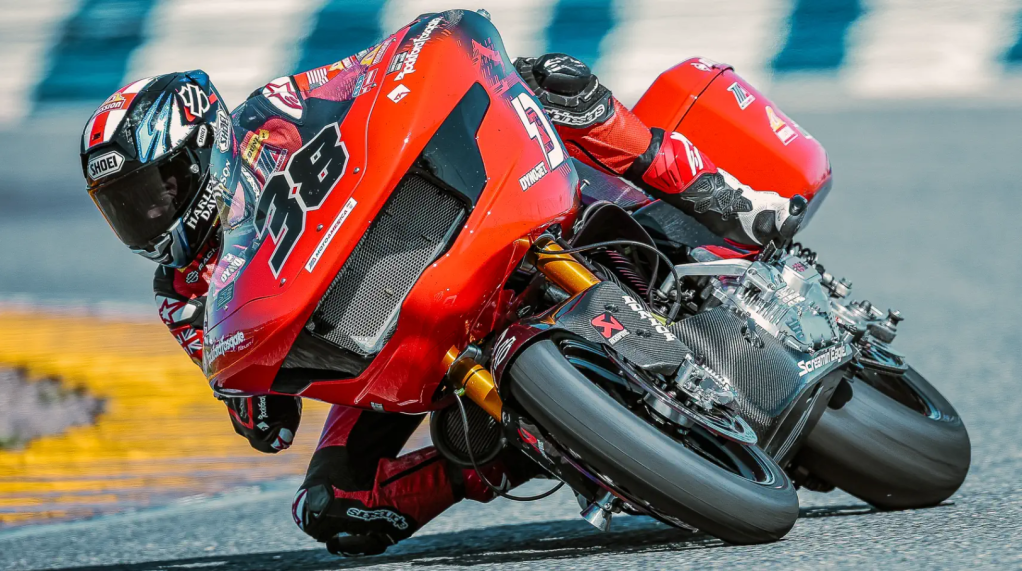
3. The new Liberty vision for MotoGP is still being defined and executed. This has the potential to have wide ranging impacts on the MotoGP product itself (with additions of the Harley Davidson Baggers World Cup- see previous blog post on this), significant technical changes in 2027, digital focus vs TV viewership, entertainment versus sport. This has the potential to change the sport and its proposition as we know it. In its interim, untested phase this may be unattractive to some potential sponsors, while others may be attracted to early entry in this new era.
Why sponsorship ROI is under scrutiny — and why Aprilia must respond
Modern marketers face increasing pressure to justify every dollar spent. Their goal is to identify and optimise the combination of marketing‑mix elements that both satisfy customer needs and deliver a measurable financial return. Sponsorship is only one tool available to them—and it is often one of the hardest to quantify.
Unlike digital advertising, where conversion, engagement, and attribution can be tracked with precision, sponsorship ROI is far more complex. How do you measure likability? How do you quantify the value of association, prestige, or fan affinity? A logo on a crowded fairing or leathers is no longer enough. Without sophisticated activation planning—content, experiences, digital integration, and conversion pathways—exposure alone has limited value.
This is especially true in an environment where many organisations are under financial pressure and expected to maximise the impact of every marketing dollar. If Aprilia’s sponsorship package is not compelling, differentiated, or clearly tied to measurable outcomes, potential partners may struggle to justify the investment—particularly when alternative promotional channels offer clearer attribution and lower risk.
Aprilia cannot afford to let these challenges persist. The implications extend far beyond the balance sheet:
• Operational capability — Sponsorship revenue underpins everything from R&D to staffing to infrastructure.
• Resource allocation — Without consistent commercial backing, Aprilia must make trade‑offs that larger manufacturers can avoid.
• Talent retention — Riders, engineers, and technical staff gravitate toward stable, well‑funded teams.
• Competitive performance — Sustained investment is essential to remain a frontrunner in a championship where development never stops.
• Long‑term commercial sustainability — A team without major sponsors risks being perceived as unstable or less competitive, creating a self‑reinforcing cycle.
Aprilia’s recent on‑track success shows what the team is capable of but without regular, reliable investment, Aprilia’s ability to remain a consistent championship contender is compromised.
Conclusion: Aprilia’s Crossroads — and the Commercial Imperative Ahead
Aprilia’s situation in 2026 is a paradox. On track, the team is delivering the strongest results in its MotoGP history, fielding elite riders and proving it can challenge the sport’s traditional powerhouses. Off track, however, Aprilia faces a commercial vacuum that threatens to undermine the very progress it has worked so hard to achieve.
When reviewing this, a clear pattern emerges. Aprilia’s sponsorship challenges are not the result of a single failure but a convergence of structural, strategic, and reputational factors. Its niche brand positioning limits the pool of compatible partners. Its global awareness remains shallow compared with rivals. The MotoGP ecosystem itself is shifting under Liberty Media’s stewardship, creating uncertainty for brands evaluating long‑term investments. And the Jorge Martín contract saga introduced instability at precisely the moment Aprilia needed commercial confidence.
At the same time, the expectations placed on modern sponsorship have evolved. Brands now demand measurable ROI, sophisticated activation, and alignment with their strategic priorities. Exposure alone is no longer enough. Without a compelling, data‑driven sponsorship proposition, any team risks being overlooked in favour of other teams that can offer clearer pathways to engagement, conversion, and brand storytelling.
The consequences of inaction are significant. Sponsorship revenue is not merely decorative; it is the financial engine that powers development, talent retention, operational capability, and competitive sustainability. Without consistent investment, Aprilia’s ability to remain a frontrunner—and to convert its current momentum into long‑term success—will be compromised.
Aprilia now stands at a commercial crossroads. To secure its future, it must redefine its value proposition, strengthen its brand narrative, and build partnerships that extend beyond logos to deliver genuine strategic value. The team has proven it can win on Sunday. The challenge ahead is ensuring that what happens on Sunday can once again translate into what sells—and sustains—them on Monday.
Let me know what you think, or if you have any suggestions for blog posts.
 the fast tomato blog
Leave a comment