
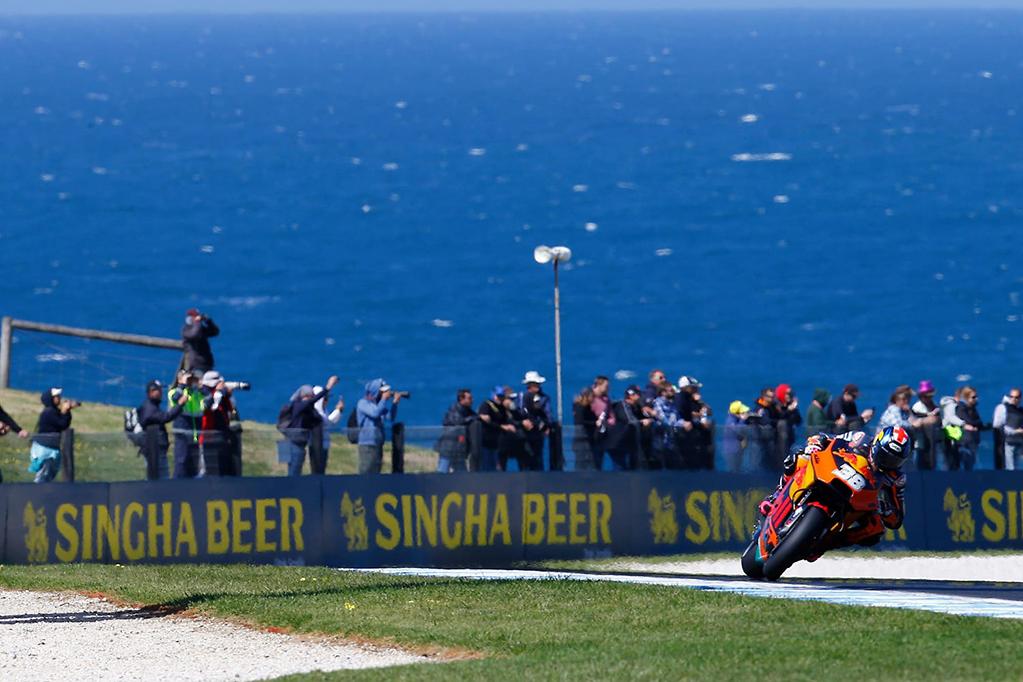
After weeks of speculation, the MotoGP Sports Entertainment Group (formerly Dorna Sports) announced today a very high‑profile casualty as part of its strategy to enhance the fan experience and accelerate growth and innovation in the sport. From 2027, the iconic Phillip Island Grand Prix Circuit will no longer feature on the MotoGP calendar. Instead, it will be replaced by a street circuit in Adelaide, South Australia.
Phillip Island has hosted the Australian Motorcycle Grand Prix for nearly 30 years and, in that time, has become a firm favourite among riders. Its high‑speed, flowing layout, dramatic elevation changes and unpredictable coastal winds consistently deliver close racing and breathtaking scenery. Valentino Rossi once described it as a charismatic track unlike any other — the kind a rider never forgets.
So, with rider support, a one‑of‑a‑kind racetrack and a strong hosting record, why did Phillip Island lose MotoGP and why did it get repurposed in the form of an Adelaide street circuit?
The answers to this are never straightforward and there are always many layers:
- Long‑standing tensions between Linfox and government stakeholders
When Lindsay Fox (via Linfox Property Group) purchased Phillip Island in 2004, he proposed an 18‑hole Greg Norman–designed golf course and a five‑star hotel to complement the circuit. The development required significant government approvals, and both local and state authorities rejected the proposal. The plans were shelved, but the fallout created long‑term tension between Linfox, government bodies and motorsport stakeholders — tension that still colours negotiations today.
2. Disagreement over who should fund major upgrades
Phillip Island did complete major safety upgrades in recent years, funded by the Victorian Government. However, Dorna wanted further investment in pit lane, paddock and spectator facilities. The required capital was substantial, and no agreement could be reached on who should pay. Without a funding solution, the contract stalled.
3. Liberty Media’s desire to move the event to Albert Park
Liberty Media, (which purchased the controlling stake in Dorna Sports), is also the commercial rights holder for Formula One. Liberty is a US‑based global media and entertainment conglomerate with a reputation for buying sports properties and transforming them into global entertainment products. The company is responsible for the hugely successful Netflix series Drive to Survive and for introducing new US street circuits in Miami and Las Vegas — the latter famously featuring a temporary “marina” built in a car park for ambience. Regardless of the theatrics, Liberty has been highly successful against its own metrics: increasing media value, boosting event revenue, expanding the fan base and elevating the fan experience across Formula One.
Liberty Media reportedly wanted to relocate the Australian MotoGP round to Albert Park — home of the Formula One Australian Grand Prix and one of the most commercially successful events on the F1 calendar. Things going in Albert Parks favour:
• only 4 km from the Melbourne CBD
• visually striking, with the lake and park key showpieces of the track precinct
• well‑serviced by public transport, restaurants and ample accommodation
• supported by strong government investment
• consistently drawing 450,000+ fans across the weekend
Albert Park is also unusual among street circuits: fast, flowing and scenic, rather than tight and claustrophobic.
However, the Victorian Government reportedly rejected the proposal to move MotoGP there — for reasons not yet made public.
4. Street circuits are unprecedented in modern top‑tier motorcycle racing
Street circuits are not part of any modern elite motorcycle championship. While some Grands Prix in the 1960s and 70s were held on public roads, they would be considered exceptionally dangerous by today’s standards. Riders in the 1970s revolted against street circuits, and by 1987 they were removed entirely from the world championship.
MotoGP bikes require enormous run‑off areas because they reach over 350 km/h and crash dynamics differ dramatically from cars. Riders slide, roll and tumble; bikes cartwheel unpredictably. Cars can absorb energy — riders cannot. Street circuits contain immovable hazards, and motorcycles need wide corner entries, long braking zones and space to lean at extreme angles. Street surfaces are bumpy, cambered, inconsistent, patched and often oily. MotoGP tyres are designed for ultra‑smooth, purpose‑built circuits. All of this makes the move to a street circuit an extraordinary challenge.
This would seemingly go against the street circuit decision, but attractive to Liberty Media’s desire for innovation and modernisation.
5. Adelaide’s long memory — and its opportunity
Historically, Adelaide hosted the Australian Formula One Grand Prix for a decade until Victoria secured the rights from 1996 onward. The loss of F1 remains a sore point in South Australia, where many still feel Victoria “stole” the event.
Fast‑forward to today, and South Australia has restored some pride by securing MotoGP from Victoria (historical revenge, or tit for tat).
The state hasn’t been idle in the years since losing F1. It has rebuilt itself as a major‑events powerhouse, securing LIV Golf, AFL Gather Round and hosting the season finale of the Supercars Championship- the Adelaide 500. The Adelaide 500 is run on a shortened version of the old F1 circuit and is one of the best‑attended motorsport events in the country, combining racing with a festival‑like atmosphere and major concerts. This may offer Liberty a scaled down preview of what to expect with Adelaides MotoGP event.
So why does all this matter from a marketing perspective?
Because marketing is fundamentally about business strategy — and we are witnessing the shift from the Dorna‑led MotoGP era to Liberty Media’s rebranded MotoGP Sports Entertainment Group. The word entertainment is not accidental. Entertainment is as important as sport is in the Liberty World. Now, it’s not that MotoGP isn’t entertaining, but it signals more of a focus to the off-track aspect of the sport- the fan experience and innovation.
Phillip Island has always delivered exceptional racing, but its facilities have lagged behind global standards. True fans accept the lack of shelter, inclement weather and often tented and temporary corporate hospitality suites and construction site offices that the teams use for their VIP guests and riders- it’s part of the charm. Albeit I will be the first to admit, the charm could have been improved over the years and wore thin at times.
But now we face the possibility that great racing may be sacrificed for a better fan experience.
This is the tension: is MotoGP a sport, or is it entertainment? Overwhelmingly we want both and not at the cost of each other.
I’ll admit, I clutched my pearls today. I am a long-term fan of MotoGP and my first thoughts was rider safety and immediate sadness about the loss of the Phillip Island ‘experience’.
Can a street track truly be safe for MotoGP? The best reference would be the Isle of Mann TT (the world’s most dangerous race conducted on a street course closed for motorcycle racing twice a year) where fatality free years are extremely rare. It produces an average of 2-3 deaths per year across all its events, racing on roads that were not designed to be raced on.
Will it produce top‑tier racing, or will we see a Monaco‑style procession through Adelaide’s streets? Will we see half throttle racing because of the very real safety issues? The show must go on after all so will that be the compromise? a show, but no sport.
Could riders revolt, as they did in the 1970s? Currently there is no formal rider’s union, only an informal riders Safety Commission with no binding authority so the responsibility will lie with IRTA (Teams Association), or the FIM (Sports Governance)- with commercial realities and the power of Liberty, will these be enough to champion the rider’s safety?
Whilst Adelaide has a history of putting on great Motorsport events, can it successfully host the world’s only and first MotoGP street race that will both be safe and have great racing- again, we want both not one or the other.
Time will tell. It is an ambitious gamble — one that I hope does not end in disaster for MotoGP fans in Australia or around the world. After all, arguably the best motorcycle racing circuit on the planet will no longer be part of the world championship after this year so this already leaves a big hole in the Championships calibre. Further, whilst MotoGP is considered the 2-wheel equivalent of Formula One it has very different realities and considerations- a copy and paste strategy is a risk to this sport and does a disservice to both sports. Motorcycling, and MotoGP have always been more culturally, economically and experientially different to Formula One- MotoGP more accessible, down to earth, less corporate, perhaps authentic. Maybe that’s why Phillip Islands charm is just fine with many who attend it religiously.
My hope is that MotoGP Sports Entertainment Group can integrate both sport and entertainment — not force a choice between them, as this decision may do.
I welcome comments and any suggestions for blog topics.
Reproduction of any or all of this blog, or other blog posts need to be by agreement only.

 the fast tomato blog
Leave a comment