
When Liberty Media — the commercial rights holder of Formula One — completed its acquisition of Dorna Sports last year, it didn’t just buy a motorsport property. It acquired the entire ecosystem behind MotoGP and World Superbikes (WSBK). And true to form, Liberty wasted no time reshaping the landscape.
Since taking control, the changes have been significant: a corporate restructure, a full rebrand to MotoGP Sports Entertainment SL (a move that signals Liberty’s entertainment‑first philosophy), and a renewed focus on modernising the fan experience.
Liberty’s playbook is familiar by now: expand commercial partnerships, grow global reach, and reinvent how fans engage with the sport.
For the uninitiated, MotoGP is the motorcycling equivalent of Formula One — the premier class of global motorcycle racing. The bikes are pure prototypes, never sold to the public, engineered with cutting‑edge aerodynamics and electronics, and capable of accelerating faster than an F1 car. Top speeds exceed 360 km/h, and the racing is elbow‑to‑elbow at those speeds. Beneath the premier class sit two feeder categories: Moto2 (single‑make 765cc engines) and Moto3 (lightweight 250cc machines with minimal electronics).
WSBK, by contrast, is production‑based. The bikes begin life as road‑legal machines — in theory, you could buy one from a dealership. That makes WSBK more relatable for everyday riders, even if the race bikes are heavily modified.
Between MotoGP and WSBK, most major motorcycle manufacturers are represented — the notable exceptions are Suzuki and Harley‑Davidson.
Suzuki withdrew from MotoGP in 2022, despite winning the championship just two years earlier, and had already stepped away from WSBK in the early 2000s. Their reasons were corporate: financial pressure, investment in future mobility, and a lack of alignment with long‑term strategy.
Harley‑Davidson, meanwhile, has never officially competed in MotoGP or WSBK. Their only historical footprint comes via their partnership with Italian manufacturer Aermacchi, which saw Harley‑badged machines win four world titles in the 1960s and 70s — long before the modern MotoGP era.
As a brand, Harley‑Davidson is not known for cutting‑edge engineering in the way Ducati, KTM, or Honda are. Their identity is built on heavyweight cruisers and touring bikes — premium‑priced machines marketed through lifestyle, heritage, and Americana. Yet despite their global brand recognition, 2025 marked the steepest sales decline in Harley’s 100‑year history, including in their home market. Sales have been falling for more than a decade. From a marketing perspective, Harley has been absent from top‑tier global brand power rankings since 2019.
Whilst there may be many reasons for this decline, two are primary: a corporate unwillingness to change, and their customers are aging out.
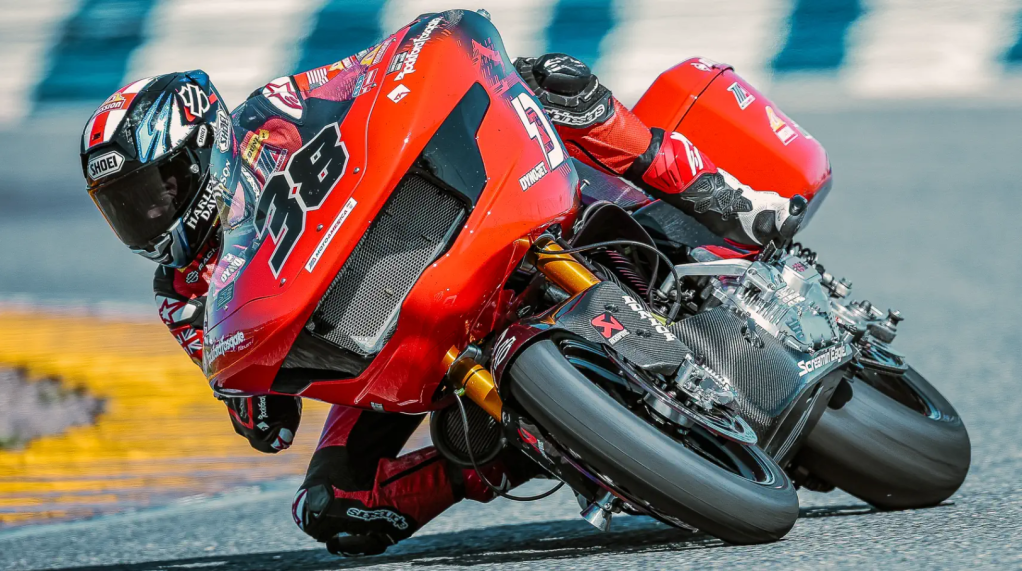
Fast‑forward to 2026, and MotoGP’s core DNA is being tested. One of the most controversial additions to the race weekend is the Harley‑Davidson Bagger World Cup, which will run as an official support category — alongside Moto2 and Moto3 — at six MotoGP rounds.
This is Liberty’s entertainment‑driven philosophy in action.
Riders will compete on full‑size V‑twin touring motorcycles — the kind associated with long‑distance cruising, not track racing. The bikes retain their hard panniers or luggage bags (“baggers” in the U.S.), a relaxed seating position, and a large front fairing. Even in race trim, these machines weigh 280–300 kg — nearly double the 157 kg minimum weight of a MotoGP prototype.
It is an unlikely racing choice, and that’s precisely why it exists.
Harley‑Davidson needed to refresh its image. Liberty needed a culturally powerful U.S. brand to help grow MotoGP’s American footprint. Baggers are said to appeal to a non‑traditional motorsport audience because of their novelty factor — and novelty is central to Liberty’s entertainment‑first strategy.
But how will MotoGP fans respond?
Online reactions have already compared the move to adding cars towing caravans to a Formula One weekend. The practical questions remain: How will the schedule accommodate this new category? Will it reduce track time for existing classes? And will the spectacle overshadow the sport? What will be the effect on MotoGP’s elite positioning? Will bagger fans embrace MotoGP and vice versa and will this be long term?
For me, this is where the tension lies. Liberty’s desire for sports entertainment may sit uncomfortably against MotoGP’s pure racing DNA. Yes, it brings a major manufacturer into the paddock — but at what cost to the brand image and positioning of the elite MotoGP series.
Baggers would seem to be a better fit, or more of a compliment the World Superbike DNA with its production-based philosophy if it is deemed to be a viable commercial integration.
Time will tell.
I welcome any feedback, or article suggestions!
 the fast tomato blog
Leave a comment